Showing posts with label Chicago Bulls. Show all posts

Friday, January 1, 2021

Hits, Misses, and Last Thoughts from The Last Dance

While we had been sitting and waiting for basketball games to return due to the coronavirus, it was a blessing from ESPN that we were able to watch The Last Dance, which chronicled the 1998 Chicago Bulls’ season in which they were able to win their sixth NBA championship.  It was a star-studded, 10-episode miniseries, as it featured Chicago Bulls’ legendary players, Michael Jordan and Scottie Pippen, and other very good teammates such as Dennis Rodman, Steve Kerr, Toni Kukoc, and others that played with Jordan.  We also had the opportunity to hear former Bulls head coach Phil Jackson and owner Jerry Reinsdorf’s perspectives, as well as other celebrities such as Reggie Miller, Patrick Ewing, Charles Barkley, John Stockton, Kobe Bryant, Gary Payton, Magic Johnson, and Larry Bird.

The 1998 Chicago Bulls at their championship parade in the summer of 1998.
(Photo: Andrew D. Bernstein/NBAE via Getty Images)

Best Moments:

Listening to the tune of L.L. Cool J’s “I’m Bad” while seeing Michael Jordan score 63 points in Game 2 of the 1986 NBA playoffs was perfection at work.  It was truly remarkable that he had come back from having broken his foot early in the season as he willed his way back, and he showed off a tremendous mid-range game and scoring skills.  His superb performance wasn’t quite enough to defeat the 1986 Boston Celtics, but this was before Jordan was able to team up with other very good players such as Pippen, Grant, Kukoc, B.J. Armstrong, and others.

Seeing Michael Jordan’s competitiveness on full display was a breath of fresh air.  All too often throughout the 1990s, we were being force fed a clean-cut, corporate image of Jordan, but it’s great to see that competitive fire and spirit finally being stoked and shown in all of its glory.  Having read the Jordan Rules many years ago, I always knew he was a fiery player and leader on the court, and it’s about time the public gets to hear how truly difficult it is for teams to win championships.   Jordan’s competitive spirit really takes the cake, whether if it’s in basketball, on the golf course, or in gambling, he’ll make sure that he will get the victory.

It was also really good to see Kobe Bryant give his perspective in Episode 5, as Jordan and Kobe had crossed paths in the 1998 All-Star game.  You could tell it was the beginning of a beautiful relationship, with Jordan as the mentor, and Kobe as the protégé, and Kobe was there to soak the knowledge from MJ so that he can win numerous titles of his own someday.  From one great of his era to another, it was really good to see their evolving friendship shown.

Listening to stories of Dennis Rodman’s wild stories were truly something else.  He took time off practices to go wrestle, to hang out with Carmen Electra in Las Vegas, and to take time off partying all night was truly wild to hear, as well as the time when Jordan went to visit Rodman to bring him back to practice.  Rodman was one of the original Bad Boys, and he was one of the best players of his time.  Rodman was pound for pound the best rebounder there was, but head coach Phil Jackson truly showed extraordinary patience to help get the best out of both Rodman and his team to get the second three-peat.

It was really nice to see how underrated a team that the 1994 Chicago Bulls were, even if they fell short in the NBA playoffs because it was in the time period where Jordan was retired.  Scottie Pippen had a terrific season that year, as he also was the All-Star game’s MVP, and Toni Kukoc had a really good rookie season.  There were sequences where the 1994 Bulls showed off great passing skills and ball movement, and it was really good to see that they ran the Triangle Offense to perfection.

Re-visiting how truly hard the road was for the 1998 Chicago Bulls to win the title made this documentary really riveting to watch.  The Bulls squared off against a tough Indiana Pacers team in the Eastern Conference Finals and barely managed to win in 7 games, and they faced a very competitive Utah Jazz squad and defeated them in 6 on Michael Jordan’s famous jumper over Bryon Russell.

It was good to re-visit the Flu Game.  That was one of the greatest games of NBA playoff history, and people were wondering what the cause was.  The most likely culprit, was probably bad pizza, even if the makers refuse to admit it.  But whatever the case, Jordan was ill, but managed to score 38 points and get his team a much needed win in Game 5 of the 1997 NBA Finals, as they would go on to win the series over the Utah Jazz.

Seeing Game 5 of the first round of the 1989 playoffs between the Chicago Bulls and the Cleveland Cavliers were truly interesting to watch.  I loved watching how it unfolded and led up to “The Shot,” in which Jordan made the shot on Ehlo, as it was good, and the game was over, and the rest was history, as the Bulls went on to win that series.

It was breathtaking to watch how close Michael Jordan was to his father and to his security guards, most namely Gus Lett, as they shared such a close bond with each other.  It was heart breaking when his father was murdered in late July in 1993, and Jordan needed time away from basketball as he had a very stressful, trying year.  It was also good to see the documentary visit his experiences with baseball and in the movie Space Jam, as that helped get his competitive juices flowing back into basketball.

Michael Jordan hanging out made for some of the best bits of this documentary.  It was also fun to see Michael Jordan rock out to some groovy tunes, as he was listening to Kenny Lattimore’s then upcoming album, From The Soul Of Man.  This even helped inspire a Twitter user to dedicate a whole page to Jordan jamming to the music.  It also was fun to see him and Jerry Seinfeld talk in the locker room, and we get to learn that Bill Wennington and trainer, Chip Schaeffer were the pop culture experts on the team and fans of Seinfeld.

The most compelling player perspectives amongst other players from other teams were Reggie Miller, Charles Barkley, and Gary Payton.  They truly believed that their teams would win, and they were able to get awfully close.  Hearing their side of the story really made for a unique experience that really had me on the edge of my seat, even though I knew that the Bulls would go on to win.

NBA reporter David Aldridge gave some great interviews, and it was quite interesting to re-watch those old Chicago Bulls-New York Knicks playoff series.   Those were some intense times.

It was very interesting to see Jordan rag on Scott Burrell.  Before the documentary, Burrell was probably known as a mere rotation player on the 1998 Chicago Bulls, and as a former first round pick that excelled at Connecticut in college, but we were really able to see how hard it was for a young player to break into a veteran team during a championship run.  It's also good to see that the vibes were all seemingly in good spirit and fun.

It was also good to hear other former players speak in this documentary.  We were able to hear perspectives from not just the well-known former players such as Scottie Pippen, Dennis Rodman, and Steve Kerr, but also the less well-known ones such as Bill Wennington, Will Perdue, and B.J. Armstrong.  It was really interesting to see Steve Kerr speak about his upbringing, as he went from a virtual unknown to winding up at Arizona and then the NBA, but it was really tragic and sad to hear about his father’s passing in Lebanon.

Not So Good Moments:

I’ve always known that Scottie Pippen was underpaid, but it seems to get in the way of the Chicago Bulls’ success stories.  It’s not fun to hear people gripe, no matter how just it is, but I understand the reason of why it may be necessary.  Pippen was one of the best players, but was being vastly underpaid, but he signed a long-term contract that the Chicago Bulls refused to allow him to get out of.  Pippen probably should’ve signed a shorter-term contract, or at least include opt-outs in case of he were to outperform his deals.

Former Bulls’ executive Jerry Krause didn’t do himself any favors during the 1997-98 season, as his comments about not wanting to bring Phil back or to bring the Bulls back after 1998 really casted him in a bad light.  The great moves he’s made for the Bulls in the past really get overshadowed by his untimely comments and unyielding desire to go for a rebuild.  

Unfortunately, Scottie Pippen doesn’t really come off super well in this documentary, and in the 1994 playoffs, he chose to sit out in the final remaining seconds of Game 3 against the Knicks because the play was not being drawn up for him and he was asked to be the inbounder, so it took away from what should have been a glamorous moment in which Toni Kukoc made the game-winning shot.  

Pippen was a very unselfish player that could do everything on the court, which made him one of the all-time great second bananas in NBA history, but choosing to sit out was a very selfish move on his part, and doubling down by saying that he would do it again did not make him look any better in retrospect.  This doesn’t take away the overall value of what Pippen contributed to his team though, as his strong all-around skills that included terrific playmaking and defensive skills really helped Jordan and the Bulls win 6 titles.

The coverage of Michael Jordan’s alleged gambling issues really seemed to take the focus off the basketball, and while it may have been necessary to cover that during the 1993 season, it just seemed like people were trying to poke holes at Jordan’s legacy.

That Michael Jordan comes across as rather apolitical is not a good look for him, and not publicly endorsing Harvey Gantt leaves a pretty bad taste in the mouth.  Jordan could’ve used his influence to bring about more social change, but it’s clear that his primary focus is on basketball, so perhaps that can’t be held against him too much.

There’s been quite the fallout stemming from this documentary, as there have been reported rifts from numerous former Chicago Bulls’ players, as Michael Jordan’s boldness from his interviews seemed to rub other former players the wrong way, namely Horace Grant.  You could argue that maybe he could’ve been a little more diplomatic in his interviews, but when you tell the truth, well, you can’t please everybody.

Missed Opportunities:

We didn’t get in-person perspectives from former players such as Luc Longley, who started on the '96-98 Chicago Bulls, or enough perspectives from Ron Harper on the 1998 Chicago Bulls’ season, as this documentary was quite Jordan-centric.  Of course, Jordan is what makes you tune in, but seeing other points of view would’ve been a welcoming addition to the process, too.

While they were giving us a tour into the past by looking into the Bulls from 1990 to 1998, what was missing was a more detailed look at former 3-time Three-Point contest champion Craig Hodges, who was also the only member of the early ‘90s Bulls’ teams to both write a letter to the White House and also wear a dashiki there.  He was on the 1991 and 1992 Chicago Bulls’ championship teams, but did not play in the NBA after that.  Hodges was very politically active, and it would’ve been good to hear his perspective on matters.

Also a missed opportunity was the possibility of taking a longer look at Cliff Levingston, who was a role player on the 1991 and 1992 Chicago Bulls’ teams, and provided the main voice of the huddle during those years.  His energy and locker room influence could’ve been talking points to explore further in those years, and it would’ve been nice to follow up on his career afterwards.

Because former Chicago Bulls’ executive Jerry Krause is now deceased, we really don’t get to see his point of view on how he ran things in the front office, and he isn’t alive to tell his perspective on why he was so eager to start a rebuild after the Chicago Bulls had won many championships.  Perhaps he would’ve stated his belief that great things don’t last forever, but to some (or many), he’ll be known as the man who helped break up a dynasty.  

That would be unfortunate in his case, as he also helped make a lot of really good moves to help the Bulls win 6 titles (such as trading for Pippen, drafting Horace Grant and Toni Kukoc, and trading for Dennis Rodman), but there will always be a what if in terms of what might have happened if the Chicago Bulls had decided to try to go for a seventh championship.

 What If?

If the documentary had decided to give a more detailed epilogue, and include Washington Wizards’ players’ point of views of Michael Jordan, would that take away from his legacy?

If Phil Jackson had decided to come back to coach the 1999 Chicago Bulls and if everyone had come back, would the Bulls have won a seventh title?  Would Jordan still have cut his hand on a cigar-cutter?  Because if he still would have gotten injured, he would have missed most of the 1998-99 season.

Could other teams have tried to get Phil Jackson, Michael Jordan, and Scottie Pippen, to lure them away if the Bulls were hell-bent on breaking up the team?  Also, if the price were steep, would that have been worth it?

Could the filmmakers have just placed a zoom call to Ron Harper and Luc Longley to get some quick interviews with them?  They were starters on the 1998 Chicago Bulls’ teams!


Overall Grade for the Last Dance:  

✰✰✰✰

4 out of 5 stars

Director Jason Hehir did a great job of piecing together such a vivid and satisfying retelling of the Chicago Bulls’ years.   It may not be perfect, as this documentary is quite Jordan-centric.  If you’re a fan of Michael Jordan, you’ll love this documentary.  If you didn’t really know who he was, you’ll find the episodes to be quite entertaining.  If you rooted for other teams during the 1990s though, you might come away disappointed, as the other teams mostly serve as mere background fodder.  In any case, Michael Jordan was truly the greatest player of his time, and his competitive fire was unmatched, and the 1990s Chicago Bulls were one of the best and most exciting teams in sports history.


5-Star Rubric in grading films, documentaries, or TV shows:

5 stars – Amazing, great the first time, and has amazing re-watch value, a timeless classic

4.5 stars – Great, great the first time, and has definite re-watch value

4 stars – Great, great the first time, solid re-watch value

3.5 stars – Very good, holds up well each time

3 stars – Good, very good the first time, but less so in subsequent viewings

2.5 stars – Okay, worth watching on cable, but not much re-watch value

2 stars – Average, may have some entertaining moments, but otherwise mediocre,  and has little to no re-watch value

1.5 stars – Not good, only worth watching on cable if you’re interested in the subject

1 star – Bad, not worth seeing

0.5 stars – Skip!


Sunday, May 17, 2020

Thoughts On Episodes 9 and 10 of The Last Dance, and Lower Back Pain

What a ride this has been.  In episodes 9 and 10, we were able to see how the 1997 NBA Finals played out, and the Chicago Bulls' 1998 run to defeat the Indiana Pacers and the Utah Jazz to win their sixth NBA championship.  Big credit to director Jason Hehir for making such a riveting, emotional documentary that us viewers on the edge of our seats, and for telling these stories that will be inspirational for not only us, but for generations to come. 

Legendary basketball players, Michael Jordan and Scottie Pippen celebrated their
sixth championship together with the Chicago Bulls,
as they helped their team defeat the Utah  Jazz
in the 1998 NBA Finals.
(Photo: Andrew D. Bernstein/NBAE via Getty Images)

We pick up right where we left off.  The Chicago Bulls squared off against the Indiana Pacers in the 1998 Eastern Conference Finals.  The Bulls won the first two at home, then the Pacers won the next game in their home building.  The Bulls were up 94-93 in Indiana in Game 4, but Scottie Pippen missed both free throws, and suddenly, we end up getting a surprise ending.....

Indiana Pacers' guard, Reggie Miller pushes off Chicago Bulls' guard, Michael Jordan
to make a game-winning three-pointer
in Game 4 to even the series in the 1998 Eastern Conference Finals.
(Photo: Vincent Laforet /Allsport)
The Bulls and Pacers then split 5 and 6, and then end up squaring off in a no holds barred, winner-take-all Game 7 in Chicago.  The Bulls had not been in many Game 7s, but they had the best player (Michael Jordan), second banana (Scottie Pippen), head coach (Phil Jackson), and rebounder in the game (Dennis Rodman), and they had won all of their home games in this series and would be playing at home once again for the deciding, pivotal game.  There was some reason to be nervous though, as this would be the last season for the quartet, and the 1998 Chicago Bulls would break up next season, with or without the championship that seemed to await them.

We get sent back to 1997, where the Chicago Bulls squared off against the Utah Jazz in the 1997 NBA Finals.  In game 1, Michael Jordan makes a game-winning shot over Bryon Russell to get Chicago a 1-0 lead.  The Bulls won the first 2 at home, but the Jazz ended up stealing the next two on their home turf to even the series.

Game 5 of the 1997 NBA Finals was the famous, Michael Jordan "Flu Game."  Really, what had most likely happened was that Michael Jordan suffered food poisoning after eating suspicious pizza served by 4 or 5 delivery people late at night.  His trainer Tim Grover told the story and advised him to not eat the pizza, for he was suspicious at the idea of pizza needing to be served by that many people.  But Jordan was hungry and it was late at night, and that was the only pizza place that was open at that hour.

In the morning afterwards, Jordan was throwing up, and he was ill, and couldn't hold any of the foods down.  The Utah Jazz got off to a big start early, and Michael Jordan looked famished and in bad shape early on.  As a Bulls fan, I was worried.

Michael Jordan scored 38 points as he put forth one of the greatest performances in NBA history
to lead Chicago Bulls to a mesmerizing Game 5 win over the Utah Jazz in the 1997 NBA Finals.
(Photo: Andrew D. Bernstein/NBAE via Getty Images)
Then, head coach Phil Jackson called a timeout in the first quarter, and suddenly Michael Jordan put on a superhuman performance, as he played the grittiest game in NBA history.  He was making basket after basket despite having the stomach flu, and nothing could beat Michael Jordan that day.  Not the flu or the Utah Jazz.  Michael Jordan scored 38 points, as he helped lift the Chicago Bulls to a 90-88 victory, as they were able to get a meaningful and tough, road win to get his team a 3-2 lead in the series.  Jordan was incredible in this game, and he put forth one of the greatest performances in NBA history.  Utah Jazz's head coach Jerry Sloan was astonished to hear that Michael Jordan was sick and still performed as well as he did in this game.

Game 6 was a pretty hard fought game, and the Chicago Bulls had some trouble closing out the Utah Jazz in the fourth quarter.  It was then when Michael Jordan and the Bulls decided to turn to sharpshooting role player and backup point guard, Steve Kerr late in the game, as he would be open when the Jazz would double off of him to guard Jordan.

Steve Kerr's clutch shot that he made in Game 6 helped propel the Chicago Bulls to win
their 5th NBA championship in 1997.
(Photo: (Photo by John Biever /Sports Illustrated via Getty Images)
Jordan drove into the paint, kicked it back out to Steve Kerr, and Kerr made the go-ahead basket from mid-range.  Scottie Pippen was able to jump a pass and tip it out to Toni Kukoc, who drove in to score on a dunk at the end of the game, and the Chicago Bulls won their 5th NBA championship in 1997.  Game 5 was Jordan's game, game 6 was Steve Kerr's game, as he finally had his defining moment as a player on the court, as he helped get his team to the series win over the Utah Jazz.

Steve Kerr talked about his upbringing, where he was not a heavily recruited player, and had to work really hard to get to where he was.  His dad, Malcolm Kerr was a professor at UCLA, and was heavily invested in his kids' lives.  Steve Kerr and his father were also great friends.  Kerr managed to get a scholarship from Arizona at basically the last minute, and his father ended up being a professor in Beirut, Lebanon.

Things took a turn for the worse unfortunately, and the violence in Lebanon resulted in tragedy.  His father was murdered in 1984, as Steve Kerr was still just in college basketball when this happened.  Like with Jordan, it was hard for Steve Kerr to talk about this difficult subject.  He focused more and more on basketball, and he ended up in the NBA.  He studied players such as John Paxson, and one day, they became teammates on the Chicago Bulls.  Paxson took Kerr under his wing to teach him the ways of being a member of the Bulls and how to be a teammate of Michael Jordan and how to earn his respect.  Kerr didn't back down from any of his challenges, and his journey helped pave the way for him to be a pivotal member of the Chicago Bulls' 2nd three-peat.

Also, we were able to see the bond between Michael Jordan and one of his closest confidantes and security guard, Gus Lett.  Lett was like a father figure to Jordan after MJ's dad died, and they shared a close bond.  Michael Jordan stayed close to Gus Lett all the way to the end, and Gus Lett was able to get a game ball after a playoff win from the Chicago Bulls in 1998.

The greatest of all time, Chicago Bulls' guard, Michael Jordan
in Game 7 of the 1998 Bulls-Pacers Eastern Conference Finals.
(Photo: Andrew D. Bernstein/NBAE via Getty Images)

Michael Jordan helped lead the Chicago Bulls to a decisive series win
to defeat the Indiana Pacers in 7 games of the 1998 Eastern Conference Finals.
(Photo: JEFF HAYNES/AFP via Getty Images)
Back in 1998, the Chicago Bulls squared off against the Indiana Pacers for a decisive Game 7 of the Eastern Conference Finals.  It went back and forth nearly the whole way.  The Pacers came charging out of the gates early on, as their strong presence inside helped give them the early lead.  The Chicago Bulls made a run of their own, due to strong perimeter play and defense.  Michael Jordan was on his game, Steve Kerr made some shots, but the Pacers kept hanging in it.

The Pacers had a narrow lead in the middle of the fourth quarter when Jordan drove the lane, and ended up getting tied up by Rik Smits, as both players would be called for a jump ball.  As Jordan and Smith leapt up to go for the basketball, Jordan won the tip over the 7-4 center, as the Bulls received the basketball, and the ball went out to an open Steve Kerr, who drilled the three to tie the game at 77 all.  The Bulls' crowd roared, and the Chicago Bulls would go on to win 88-83 over the Pacers and on to face off against the Utah Jazz later on.

In the 1998 NBA Finals, shockingly, the Utah Jazz pull off a game 1 win in their home building in OT, as they wore down the Chicago Bulls in overtime.  The Chicago Bulls won the second game to even the series.

In game 3, the Chicago Bulls blew the Utah Jazz out of the water, as they held their opponents down to just 54 points, and won by 42 points.  In game 4, the Chicago Bulls won again to get up to a 3-1 series lead, and there's some talk about the Bulls winning in Chicago in what could be Jordan's final game ever.  Only though, it seems as if no one was quite ready for the season to be over yet.

Game 5 turned out to be the Chicago Bulls' sloppiest performance, as they dropped this game to the Jazz at home, as they then went out on the road to play in Utah for Game 6.  It was a truly hard fought game in which the Bulls played with an injured Scottie Pippen, who was playing through back pain, and for periods at a time would go into the locker room to ease his lower back pain.


Chicago Bulls' legendary forward, Scottie Pippen scored early on with a dunk,
but dealt with back pain for the rest of the game in Game 6 of the 1998 NBA Finals.
(Photo: Nathaniel S. Butler/NBAE via Getty Images)
Scottie Pippen had scored early on with a dunk, but that dunk unfortunately severely tightened his lower back, as he ended up having severe lower back pains.  But the Chicago Bulls were determined to have another legendary performance in NBA playoffs history.

Re-watching Scottie Pippen play through a lower back injury in Game 6 of the 1998 NBA Finals was truly one of the grittiest performances I've seen in NBA history, along with the Michael Jordan "Flu Game" in Game 5 of the 1997 NBA Finals.  As someone who has played a fair share of pick-up basketball, I've had a couple of lower back injuries myself over the past several years, and it is definitely not easy playing through that pain.

The first time when I injured my lower back really caught me by surprise when it happened to me.  Back then, I injured my back was about 5 years ago, when I went up for a simple layup that I would normally make while I was just shooting around, but I extended myself a bit too far, and felt pain in my lower right back.  I couldn't play for the rest of that day, and didn't do any serious basketball-related activities for a month.

The second time that I experienced lower back pain happened about 20 years after the memorable 1998 NBA season, as this time actually happened in an outdoors, pick-up basketball game in the summer.  That day, I was shooting the ball really well, and I was making a lot of threes that day.*  (In 2018, I was a far different player than how I played in 1994.  During the 1990s Bulls years, I was an inside player that relied on energy and hustle to grab rebounds and to defend multiple positions, and I was an agile big man when I was a kid.  In 2018, I'm now much more of a perimeter player, and I'm now primarily a jump shooter and facilitator in basketball games.  I didn't shoot threes in the 1990s, now as an older player, I shoot mostly threes and mid-range jumpers nowadays.)

*My three-point shooting prowess that day had caught my friend by surprise, and I was somewhat surprised myself that I was making a lot of outside shots, plenty of which were contested.  This by far had to be one of my best basketball days in the summer at that point.  Then, on one play, I went for a loose ball with an opponent, and I reached out to go get it, and......POP!  I felt pain in my lower left back as I was bent over, and had missed out on the loose ball opportunity.   When I tried to straighten out my back, I knew I couldn't play for the rest of those games that day.  I sat down to hang out with my friend on the sidelines, and then after that, the pain was excruciating.

When I got up from the concrete, I really felt it.  I had a hard time walking without feeling pain in my lower back, I had to change my sleeping habits for a couple of weeks.  I didn't feel comfortable performing any serious basketball-related activities for a month after that.  The point is, lower back pain hurts and the pain can be tremendous.  Scottie Pippen showed great toughness and courage by playing through his lower back injury to help get the Bulls a pivotal and decisive series win in Game 6 of the 1998 NBA Finals.

Scottie Pippen had injured his back pretty badly after leaping up to score on a dunk early in the game.  Seeing him play through that pain was a really gritty, gutsy thing for me to see.  His mobility was severely hampered, but he was able to play for spurts at a time, especially in the second half, and he was able to make some shots in the low post, and he still made some good passes to help the Chicago Bulls.  Most importantly, his presence really helped the Bulls, as he gave his team the threat of having another dynamic, versatile player out on the floor, and he helped allow the Bulls get back into the flow of things, as Chicago was able to rally back in the fourth quarter.

Michael Jordan (to the right) and Scottie Pippen (to the left) having a discussion
in game 6 of the 1998 NBA Finals.
(Photo: Andy Hayt/NBAE via Getty Images)
Michael Jordan truly had another legendary performance as he was determined to help get his team the win, and seeing his final minute in the Chicago Bulls' uniform described by Bob Costas was truly an experience to watch.

Michael Jordan drove into the lane to score on a quick layup to cut Utah Jazz's lead to one, as the Bulls trailed 86-85.  The Jazz threw the ball down to Karl Malone, who was being defended by Dennis Rodman, and Jordan came in from the blind side to poke the ball away from Malone to get the steal.

The Chicago Bulls do not call a timeout, and Phil Jackson lets them play it out.  He decides that he doesn't want the Jazz to get their defense set, and he lets Jordan make the play call.  Everyone is at the edge of their seat to see what will happen next....

Tick....tick....tick.....

We're at the edge of our seats.  NBA fans everywhere are holding their collective breaths.  A young Kobe Bryant and LeBron James are out there, watching this very game, tuning in to see what happens next.  We sense that Jordan is going to take the final shot, yet as the clock has not stopped, we sense that we may not exactly know for sure if he will.  But if he does, this could be a career defining moment in not only Michael Jordan's history, but in the history of the NBA.

Michael Jordan dribbles the ball up the court, sizes up his defender, Bryon Russell, thinking about his next move as he scans the defense.  Jordan dribbles to his right, Bryon Russell stumbles over his feet while desperately trying to guard Jordan, Jordan creates the separation he wanted, Jordan crosses back over to his left, and......

The greatest shot made in NBA history!!!  Michael Jordan makes the game-winning
and series-winning shot to get the 1998 Chicago Bulls the NBA championship,
and the Bulls ended up winning their sixth championship.
(Photo: Fernando Medina/NBAE via Getty Images)

Michael Jordan makes the game-winning jumper to get the Chicago Bulls a 87-86 lead!  After a timeout, John Stockton heaves up a three, but it falls short, and the Bulls win!  Game, series, match.  The Bulls win!  It is a nice feeling, and it is really sweet to see the Chicago Bulls win the sixth NBA championship.  All that hard work paid off, and the last dance officially has been well worth the journey.

Michael Jordan and Ahmad Rashad greet a young Leo DiCaprio at the end of Game 6 of the 1998 NBA Finals,
right after the Chicago Bulls defeated the Utah Jazz to win their sixth NBA championship.
(Photo: Andy Hayt/NBAE via Getty Images)

Re-watching the Chicago Bulls win their sixth championship was an amazing feeling.  They had a hard journey to get back to the top, and it was very satisfying to watch them to get the crowning achievement of winning the title in the 1997-98 NBA season that would be known as "The Last Dance."  Michael Jordan certainly enjoyed celebrating the Bulls' sixth title win, he got to hang out with Titanic star Leo DiCaprio, former NFL player, broadcaster, and his close friend Ahmad Rashad, and he also found time to play the piano!

The 1998 Chicago Bulls at the championship parade in Chicago.
(Photo: Andrew D. Bernstein/NBAE via Getty Images)
It was a feel good ending to such a trying, emotional, and at times turbulent journey.  Executive Jerry Krause had helped put this team together, and then he and owner Jerry Reinsdort would proceed to dismantle it all just before the 1998-99 season to start a rebuild.  Michael Jordan headed off to the sunset into retirement, Scottie Pippen would cash in on his payday via sign-and-trade with the Houston Rockets, and other players would play on various NBA teams.

The Epilogue:

None of Jerry Krause's teams ever came close to what he helped build with the 1990s Chicago Bulls' teams, and I'd like to think that the Chicago Bulls may have been able to get a seventh championship if the Jerrys had decided to keep the team together.  Michael Jordan became an executive with the Washington Wizards, then suited up to play one more time with the Wizards, made an All-Star team, but the Wizards didn't make the playoffs with Jordan back one more time.  He couldn't quite recapture the magic he had in Chicago with Scottie, Phil, and the gang, and he could never quite get the team chemistry to that level in Washington D.C.  Rip Hamilton came the closest to being an MJ protege, Rip had one promising season as Jordan's teammate before being traded to Detroit, and he would end up being an All-Star and winning an NBA championship in 2004 with the Pistons, seasons after the infamous Hamilton for Jerry Stackhouse trade.  

Dennis Rodman wasn't the same after 1998, and no NBA team appeared to trust him like Phil did in Chicago.  Scottie Pippen wasn't quite the same legendary player he was in Chicago after 1998 either, but after he didn't quite fit in with Houston, he ended up being a solid player on some good Portland teams that fell short to the Lakers in the early 2000s.  Toni Kukoc was the primary scorer of the 1999 Bulls' teams, but he felt uncomfortable in that role, as his shooting percentages dipped that year.  He ended up being an NBA journeyman in the 2000s.  Also, Steve Kerr ended up winning another championship as a member of the 1999 and 2003 San Antonio Spurs' teams, later became a TNT analyst, then a Phoenix Suns executive, went back to being a TNT analyst, and now is a legendary head coach with the Golden State Warriors.    

As for myself?  Let's save that for another day.  

The 1997-98 season was the last great season in Chicago's NBA history, if this was the note for Jordan to leave off in Chicago, this was a truly amazing way to go out.  Hats off to Michael Jordan and the Chicago Bulls, and thanks for the memories, and for bringing forth unforgettable seasons in the NBA.  

Thanks for reading this article, and if you want, feel free to follow me on Twitter at @AlanLuSTL.

Sunday, May 3, 2020

A Sort of Recap and Thoughts on Episodes 5 and 6 of the Last Dance Documentary

Taking a trip back down memory lane.  Michael Jordan was larger than life, especially back in the 1990s, but this documentary goes to great lengths to show that it isn’t easy being him. People followed him everywhere, he was viewed as a saintly role model, but every now and then, we’re reminded that as great as he is, he is still human, and every human has positive traits and flaws alike.

Michael Jordan and Kobe Bryant went head-to-head in the 1998 NBA All-Star Game.
(Photo: HENNY RAY ABRAMS/AFP via Getty Images)
We start off by taking a look back at the 1998 All-Star game, as Michael Jordan plays in his final All-Star game as a Bull against a young Kobe Bryant.  It was nice to watch Kobe tell stories of Jordan providing guidance to him, and seeing them play one-on-one against each other in that game, as we were given a look at the two greats go head-to-head, with Kobe being the future of basketball after the Jordan era.  Kobe played well and had some good moments, but Jordan played really well, and he ended up taking home All-Star MVP honors as he was the best player in the game.

Michael Jordan wore his Air Jordan 1s in 1984 and 1998.
(Photo: Sneaker News, via John Kim's article at sneakernews.com.)

Later, we see Michael Jordan play at Madison Square Garden in his final regular season game in 1998 against the Knicks as a member of the Chicago Bulls, and he decided to wear his vintage, Air Jordan 1 “Chicago” shoes that he debuted in 1984.  Jordan played tremendously, and he put forth another legendary game.  The shoes certainly looked cool, and it was an homage to the shoes he wore as a rookie, but it also left his feet bleeding.  Wearing 14-year old shoes is an insane idea, especially when the time period was the 1990s, as shoes don’t exactly have a long shelf life the moment you put them on.

We are then treated to the 1992 season, where the Chicago Bulls begin their quest to defend their title, and they dismantle their opponents easily.  They make quick work out of their opponents as they win 67 games in the regular season.  

The 1992 Bulls-Knicks' playoff series was fun and intense, and a sign of things to come in 1993.
(Photo: Modern Notoriety, via Oscar Castillo's Article at Modern Notoriety.)
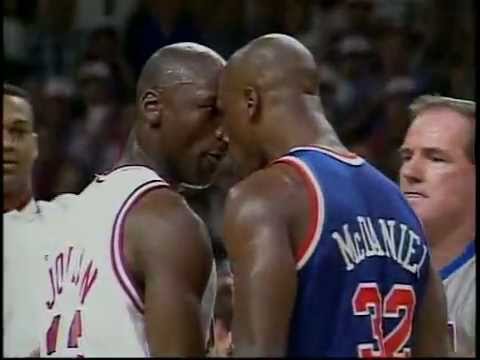
The documentary breezed through the 1992 series against the New York Knicks, which was actually a harder series than viewers were led on, as the Bulls won that one in 7 games. We did get treated to some nice Michael Jordan highlights, including one where he scored on Xavier McDaniels and proceeded to give it to him verbally.

After dispatching the Cavaliers in the Eastern Conference finals, they then faced the Portland Trail Blazers in the 1992 NBA Finals.

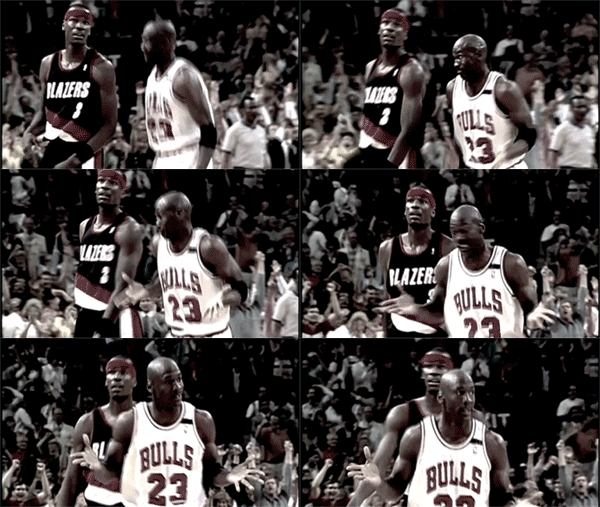
Much was made in the press about the supposed Michael Jordan-Clyde Drexler rivalry.  In the first game though, we learn that Drexler was no match for Jordan.  The Blazers were unprepared for his onslaught of points, as Jordan made 6 threes in the first half, and dropped the famous shrug after he made the 6th three towards the scorer’s table as he waltzed back past Cliff Robinson in the process.  The Bulls handled the Blazers, and won in 6 games, as they won their 2ndNBA championship.


Ah yes, the famous Michael Jordan Shrug Game,
as he made 6 threes in the 1st half of Game 1 of the 1992 NBA Finals.
(Photo via Giphy.)

Michael Jordan and Scottie Pippen then were able to go to the 1992 Olympics to play for the Dream Team, and it was fun watching them hang out, and we saw the famous scrimmage game where Magic Johnson and Michael Jordan went head-to-head in practice. Magic’s team was up, and then Jordan put on a barrage of points to win the scrimmage.

Future Chicago Bulls' teammates, Toni Kukoc and Scottie Pippen played against each other in the 1992 Olympics.
(Photo by Richard Mackson /Sports Illustrated via Getty Images)

Later on, we’re introduced to Jordan’s future teammate, and Chicago Bulls’ forward, Toni Kukoc from Croatia.  He’s a 6-10 versatile point forward who had a lot of the same skills that Scottie Pippen had, except he was younger, fawned over by executive Jerry Krause, but he had zero NBA experience, and wasn’t nearly the defender that Pippen was.  Kukoc was a good player back in 1992, but he had no idea what was in store for him when he first was going up against both Jordan and Pippen.  As we learned from the Dream Team documentary, his first game against them was brutal, but it's good to hear from Kukoc's point of view this time around.

First game, Jordan and Pippen took turns to defend Kukoc, and it turned out to be an embarrassing game for Kukoc, as he struggled mightily in the first half, and scored just 4 points in his team’s blowout loss to the Dream Team.  Jordan and Pippen were gunnin’ for him, not because of him specifically, but more because he was the new player that Krause was gushing over while the Chicago Bulls were winning championships.

In the Gold Medal game, Toni Kukoc played well, and he showed a resiliency by not folding and by playing his game.  He bounced back by scoring 16 points, and he showed off passing wizardry, as he showed off his strong playmaking skills that especially dazzled in transition.  Of course, the Dream Team easily won the match, as the U.S. squad was stacked and loaded with superstars and all-time greats, and USA went on to get the gold, but it was clear that after the gold medal game, Kukoc could certainly be a solid player in the NBA.  (And he did end up being a solid NBA player for the Chicago Bulls.  His versatility, strong playmaking skills, and ability to create mismatches in his team’s favor definitely helped the Bulls, and he really strengthened the Bulls’ second unit by giving Chicago another dynamic playmaker that they can count on.)

Chicago Bulls' legendary superstar guard, Michael Jordan,
and 44th president of the United States Barack Obama were both featured in The Last Dance.
(Photo: EPA/SHAWN THEW/CP Images, via ET Canada.)
Also, somewhere in the episodes, the 44thpresident of the United States, Barack Obama talks to the documentary, and commentates on Michael Jordan.  Growing up as a Chicago Bulls’ fan, there really wasn’t anything shocking in these episodes, as Jordan’s ultra-competitiveness, and his love of golf, cigars, and gambling isn’t exactly new information.  Perhaps the most controversial aspect was disclosing Jordan’s political stance, or seeming lack thereof in the public eye.  As where Muhammad Ali and LeBron James are/were not only great athletes but are/were also social activists, Jordan seemed to be unconcerned with politics, but almost solely occupied on staying dominant at basketball.  (Side note: How many cigars did Michael Jordan smoke a day???  To be THAT athletic and smoke cigars as just beyond me, as cigars are not healthy at all.)

(2nd side note: The Chicago Bulls did have a player that was a political activist in the 1990s, but he hasn't been featured in any of these episodes, which would be sharpshooter, and 3-time Three-Point Contest champion, Craig Hodges, who famously wore a dashiki when the 1991 Bulls greeted George Bush at the White House, and confronted the then-president about social issues.  Unfortunately for Hodges, he played only one more year after that as the Bulls did not re-sign him after the 1992 season, and he did not end up playing in the NBA again after that. Hodges also appears to have been mostly omitted from this documentary, despite having contributed to the 1991 and 1992 NBA championship teams for the Bulls.  A separate documentary on Hodges' NBA playing career and political activism would have been quite interesting.  It is also potentially worth noting that Hodges later criticized MJ for various comments in the Last Dance episodes, as it seems to be implied that MJ and Hodges seem to have a particularly frosty relationship with each other, or so it seems stemming from Hodges' comments in which he aired many grievances about how MJ conducted himself in the documentary.)  

To me, Jordan never has really been a political activist, and when asked, he has been quoted as having said, “Republicans buy sneakers, too.”  What’s good for Jordan financially may have missed the mark socially.  He had an opportunity to endorse democrat, Harvey Gantt for senate, but opted not to but said he gave a donation instead, but Gantt ended up losing to Jesse Helms in the 1990 senate race.  I never really thought about Michael Jordan as a political activist, so maybe him taking a stance was a missed opportunity, but I’ve always thought of Jordan as a tremendous and legendary basketball player.

In Episode 6, the main focus was on the 1993 season, while they also spent some time covering the 1998 regular season in the later months.  The critical aspect was Michael Jordan’s extreme competitiveness, but also how the spotlight was never really off of him.

The 1993 season started off similar to the 1992 season, as they were on a quest for a three-peat, but suddenly we get sidetracked because of Sam Smith’s book, “The Jordan Rules.” Here, the public is made aware of Jordan’s tough, aggressive, and at times potentially vociferous leadership and management style, as the book claimed that he rubbed some of his teammates the wrong way as a result.  

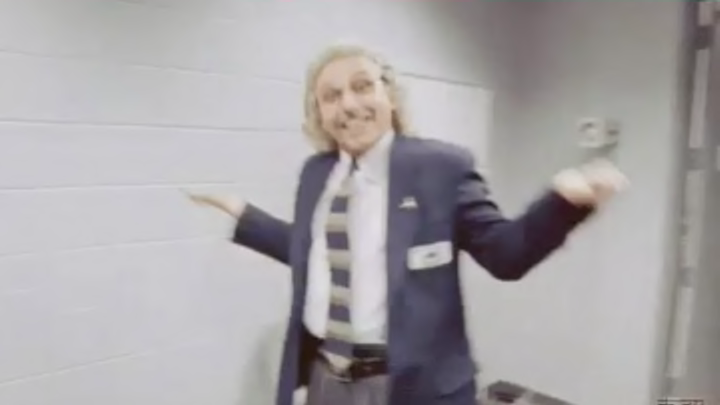
The United Center's security staff member, John Michael Wozniak
did the shrug of his own, after beating Michael Jordan in a game of quarters.
(Photo: 12Up, via Mark Powell's article at 12up.com.)
Another revelation back then that was that he was a lover of gambling, and so another focus was whether or not if he had a gambling addiction problem.  Jordan made it clear that he didn’t have an addiction problem, but rather is very competitive.  In one aspect, he challenges the United Center security guys to a game of quarters after seeing them play, and he places bets due to his intense competitiveness. To some, his extreme competitiveness may be a bit off-putting, but it also can be sort of endearing, in a way. It depends on how you look at it. Of course, the public ended up being doused with claims of Jordan’s supposed gambling problem, as that took a bit too much of the spotlight.

The documentary people interviewed David Aldridge and Charles Barkley, and they gave great bits of information on the 1993 Chicago Bulls’ season.  Sue Bird also was interviewed later on, where she talked about the famous (or infamous) John Starks’ dunk in the 1993 playoffs, as people have held debates on whether or not if he actually dunked on Michael Jordan.

The most intense rivalry of my day was watching the Chicago Bulls-New York Knicks games, and that was a prime focus of the 1993 playoffs.  As a Bulls' fan growing up, I did not like the Knicks one bit.  I did not like how they played, I thought they played dirty, and I didn’t think there was much of a place for extreme physicality in basketball.  But the Knicks did play very good defense, as their extreme hard fouling and intimidation tactics were factors in defeating their opponents.  They were also led by Hall of Fame coach, Pat Riley, and superstar center, Patrick Ewing.  Make no mistake, the Knicks’ teams were very tough though, and they placed a great deal of emphasis on defense and by turning games into an absolute grind to get wins.

The 1993 Bulls dropped the first two games on the road against the Knicks, and there was some worry and doubt, as bad memories from their early days against the Bad Boy Pistons had seemed to sprung about again.  Suddenly, the media focus ended up being on Michael Jordan’s Atlantic City trip with his dad, and if he had a gambling addiction problem, on top of whether or not if the 1993 Bulls had it in them to come from behind to win the series. The Bulls certainly had enough fuel, and they went on to win four straight, including a tough, hard-fought Game 5 where they stuffed and stripped, and ultimately stopped Charles Smith from scoring to win that one on the road.  So essentially, the Bulls win in 6.

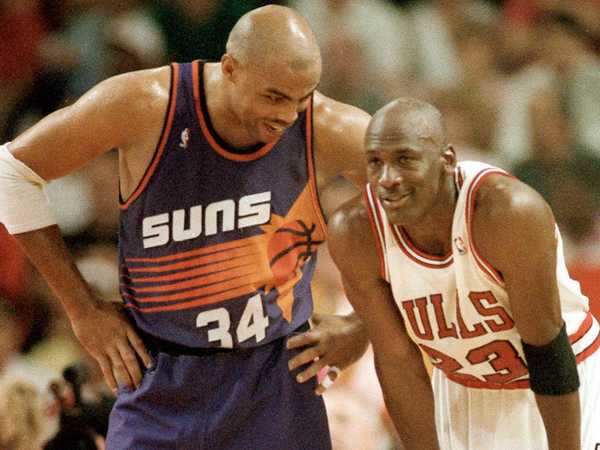
Michael Jordan (pictured right) and Charles Barkley (pictured left) went head-to-head in the 1993 NBA Finals.
(Photo: John Swart/Associated Press, via Business Insider.)
Later on, they squared off against the Phoenix Suns in the 1993 NBA Finals against regular season MVP Charles Barkley.  Again, as a Bulls’ fan growing up, I thought Michael Jordan should’ve been the MVP, but the media weirdly voted for him, and then Karl Malone for the MVP years later. But individual awards don’t really matter that much in this documentary, anyways.

The Chicago Bulls win the first two games on the road, and it appears that they have a clear, easy path to win the title.  Game 3 comes along, and it is a marathon that goes into double OT.  I remember it as the game that went on very long, and then Charles Barkley dominated in double OT, where he then intercepts a terrible Stacey King pass to score, and the Suns steal Game 3 on the road.  You the viewer must be thinking, “I know where this is headed, first team that wins a home game wins the series, right?”

Yep, pretty much.  The Chicago Bulls win at home in Game 4 handily.  But suddenly, the fans start pre-maturely celebrating before Game 5, and the Bulls get wrecked and drop another one to the Suns. The Bulls are up 3-2, but have to go on the road to win the series.  Also, another interesting note, as a kid, I remember watching a young Richard Dumas play, and he seemed to play his best basketball in Chicago.  He played really well in this series, specially at the United Center, and I remember thinking that he was like a young Shawn Marion (except I didn’t know who Marion was back then, because it was 1993), as I remember thinking Dumas to be a young star on the rise.  Unfortunately for Dumas, he didn’t have many good years left in the NBA, as it later turned out that he had a substance abuse problem.

Fast forward back to 1998, it’s close to the end of the regular season, and the Bulls get their 60thwin over the Horace Grant-led Orlando Magic.  Michael Jordan gets Phil’s blessing to go celebrate and have the squad take the practice off with him, and they go out golfing and have a good time at that.


John Paxson's best moment of his NBA career, he made the game and series-winning shot in Game 6 of the NBA Finals.
(Photo: Andrew D. Bernstein/NBAE via Getty Images, via Bright Side of the Sun.)
 We then get to see Game 6 and how it plays out.  Ah yes, the John Paxson game.  Barkley played well, but Jordan played really well, and he showed his dominance on both ends of the floor.  Late in this game, Horace Grant makes a pass to John Paxson, who makes the game-winning three-point shot, and clinches the series win, and the third championship for the Chicago Bulls.  Michael Jordan averaged 41 points per game in the NBA Finals, which is the most ever by an NBA player, to this day.

The Bulls get to celebrate once again, but this time, the mood seems different than how it was in 1992. The feeling is strangely more somber and the feeling seems to be more relief than joy from Jordan and the Bulls. The 1993 season was very fun to watch as a viewer, as the Bulls and Knicks had an intense rivalry, and the top Bulls-Suns games went down to the wire. That season was a fun time, and it’s a good point to close the chapter.  It’s after the 1993 season where tragedy strikes though, as Michael Jordan loses his dad to an untimely death, and Jordan ends up retiring for the first time while deciding to give baseball a try.

Anyways, that’s my sort of recap and some of my thoughts on Episodes 5 and 6.  I didn’t really know how to parse this stuff out, as there was a lot of stuff to unpack, so I decided to just write what I thought about when watching these episodes.  Thanks, and feel free to follow me on Twitter @AlanLuSTL

Sunday, April 26, 2020

Takeaways from Episodes 3 and 4 of The Last Dance

Former Chicago Bulls' star forward, Dennis Rodman, and
former Chicago Bulls' legendary head coach Phil Jackson
were at the center of episodes 3 and 4 of the Last Dance.
(Photo: Scott Cunningham/NBAE via Getty Images)

What a remarkable, wild ride this has been, as we’re treated to a Dennis Rodman and a Phil Jackson episode, and a look back into the journey of the Chicago Bulls from 1989-1991 while we follow them on their quest to eventually win their 6thand final title in 1998.

Dennis Rodman was one of my favorite players to watch when I was growing up.  I admired his hustle and ability to get after every play, and as a kid, I modeled my game after him.  Rodman was the rebound king and was a tremendous defender and competitor, and I loved his ability to rebound, defend, and irritate his opponents.  I didn’t love how the Bad Boys' Detroit Pistons teams played, but I was fond of how Rodman played his game.

In elementary school, I grew up taller than most kids, and I played the power forward position for a youth league team where a friend of mine was the best overall player there, as he was the team’s point guard and leading scorer.  I wasn’t the most skilled player on offense, but I set out to play like Dennis, or at least to my interpretation of how he played.  I aimed to grab every rebound.  I reveled in shutting guys down on defense.  I played very hard, to the point of exhaustion in every game I played back in those days.  My team ended up going 5-0 and won the youth league championship in a local YMCA league. 

1991 was my first foray into the game of basketball.  I remember watching the 1991 NBA Finals, and my first memory of basketball was the moment where I fell in love with the sport.  It was Game 2 of the 1991 NBA Finals, Cliff Levingston passes the ball back to Michael Jordan, and he drives in and gracefully maneuvers to score on the iconic, switch of hands layup beautifully to score the basketball. From that moment, I was hooked on watching this game.

YouTube video is courtesy of the Michael Jordan Archive at: https://www.youtube.com/watch?v=IiSdb16N_Dg

The Chicago Bulls were my favorite team, and it was a tremendous moment in time watching Michael Jordan, Scottie Pippen, and Magic Johnson square off in the NBA Finals.  It was like watching a passing of the torch moment, and I knew that something special was happening with Jordan and the Bulls.
  
Michael Jordan's memorable game and series-winning shot that he made,
aptly named "The Shot" in Game 5 of the 1st Round against the Cleveland Cavaliers.
(Photo: Ed Wagner Jr./Chicago Tribune/Getty Images, via Yahoo)
Another great moment was watching the 1989 first round series that took place between the Chicago Bulls and Cleveland Cavaliers.  Just seeing Michael Jordan play, make the game-winning shot, and that heroic, fiery competitiveness was truly awesome to watch.  I totally agree with Jordan and Ron Harper, that Lenny Wilkens put the wrong guy (Craig Ehlo) on Jordan, that Harper should've been granted the opportunity to guard him instead late in that game.  To me though, Jordan still would’ve made the shot, but Harper probably would’ve made it a slightly tougher matchup.

The backdrop of the 4thepisode centers around Phil Jackson, as he actually has a lot more similarities to Dennis Rodman than what was initially believed.  Not only is he also a 6-8 tall person that played power forward in the NBA, Phil Jackson was an atypical, laid-back person that believed in spirituality, and they shared a common interest in learning Native American history.  He was a laid-back coach, and he filled in after Doug Collins pushed the Bulls to the 1989 Eastern Conference Finals, and Jackson helped the Bulls punch it in to win the title in 1991.

Episode 4 comes to a heartbreaking close, as Jerry Krause gives an impending doom interview about how he won’t bring Phil Jackson back after the 1998 season, which pretty much seals the 1998 Bulls’ fate as that this will be the last time they will play for a title.  

Krause’s untimely comments towards Phil Jackson came just before a regular season game against 1997-runner up, the Utah Jazz.  The Bulls got off to a fantastic start on the road, as they were up 47-24 early on.  

But suddenly, it was then the Jazz come roaring back.  They manage to cut to 8 in the third quarter, and suddenly the Jazz end up going all the way to get a comeback win as the Bulls are defeated, 101-93.  The viewers are treated to a moment of stunned, deafening silence, and the episode leaves us wondering if the Bulls will be able to pick up the pieces to win their sixth title, as we’re left shocked in this gut-wrenching, tear-jerking end to such an exhilarating ride of a fourth episode. (Don’t worry, the Bulls do pick up the pieces and recover.  The Chicago Bulls eventually become the NBA champions in 1998.)

Tuesday, April 21, 2020

Takeaways from the Episodes 1 and 2 of the Last Dance Documentary

Episodes 1 and 2 of the Last Dance was every bit as good as I was anticipating it to be.
(Photo: Clutch Points, via Paulo Songco's article.)

Watching Michael Jordan score 63 points in Game 2 of the 1986 NBA playoffs to the tune of “I’m Bad” by L.L. Cool J was phenomenal.  Even more impressive was that he came back to the 1985-86 season after having broken his foot months earlier to get the Chicago Bulls to the postseason, and just seeing Jordan display his tremendous mid-range game was surreal to watch.  That was one of many legendary performances he put forth throughout his career.   Watching that performance cements that Jordan was the greatest mid-range shooter in NBA history, and to me, he'll always be the greatest ever to have played the game.  If only if he could have had Scottie Pippen, better players around him, and Phil as the head coach, the Bulls would’ve won that game.  But since the 1986 Boston Celtics are also a legendary team, the Bulls just didn’t quite have enough to get the win in overtime.

Whoever was Scottie Pippen’s agent should have absolutely have told him to refuse the deal, and Scottie Pippen should’ve been told that something called “opt-outs” exist.  I know that Pippen wanted to be financially secure, and signing a 7-year deal sounds like the right thing to do, but inflation kicks in, and suddenly his contract no longer is as much years later compared to what the rest of the players were earning in the league.  From what I’ve read and heard, it seems that just about everyone around him, including his agent, Jimmy Sexton, and the owner Jerry Reinsdort advised him not to sign the deal, but he did, which seemed to make sense in 1991, but no longer seemed to be that feasible for him in 1997, especially since he ended up being on a far below, market-value deal.

Pippen was arguably the 2nd best player in the entire NBA, and it was ridiculous that he was the 122nd highest-paid player in the 1997-98 season.  Of course, the Jerrys (Krause and Reinsdorf) weren’t willing to re-negotiate, and Pippen almost torpedoed the magical 1998 season by waiting until the start of the regular season to begin his rehab, and that he demanded a trade.  Thankfully, the Bulls found a way to get him back to the fold later on, as they would win their 6th and final championship, but it’s no doubt that the contract that Pippen was forced to stay on combined with the Jerrys’ refusal to renegotiate made it an absolute certainty that he would leave to hit free agency after the 1997-98 season.

It was really interesting to watch the tales of how Michael Jordan and Scottie Pippen grew up, as they both experienced hardship, from Jordan being cut from his high school team, to Pippen’s dad and brother being paralyzed and unable to walk, there were some real gut-wrenching moments in seeing what they went through. 

Jerry Krause is going to get hit HARD in this documentary.  The mercurial, misanthropic, reclusive former Chicago Bull executive is in the basketball Hall of Fame, but he's not exactly a people person.  He did not handle the personal situations very well, because he couldn't take his ego out of the equation.  His tremendous desire to get credit made it difficult for anyone to appreciate his role in building a historically great team, and his unfortunate desire to want to rebuild left a bad taste in many people's mouths (including my own), and the fact that he was so willing to break up arguably the greatest team ever made it tough to ever let go of what he did.  

The team's breakup seriously impaired basketball overall, because we were deprived of the possibility of a team that could have perhaps risen to one day overtake the Bulls.  Therefore, after the 1998 season, the Bulls just sort of abdicated the throne because Krause wanted his rebuilding project.  As a result of this, Jordan and the Bulls were deprived of a chance to defend their 1998 title and were basically forced to walk away.  

Watching the 1990s Chicago Bulls was one of the greatest joys of my childhood, and seeing them break up sent me spiraling into a state of depression, and there was a time where I hated watching the NBA as a result, because I was angry at the Bulls' management for breaking up such a great team.  Watching the 1991-98 Chicago Bulls were great times, and I wanted the times to last forever.  My love for the NBA has grown back to where it was, and I've more or less gotten over the breakup, especially since it has already happened and you can't change the past.  But to this day, I have not forgiven Krause for breaking up such a historical and monumental team, but I still respect his ability to build teams.

There was not enough Dennis Rodman or Toni Kukoc.  I’ve been told we will see more of Dennis Rodman, who was the best rebounder in the NBA, and is a Hall of Famer, and Kukoc was an uber-versatile 6th man that like Pippen and Jordan, could do everything on the court.

The soundtrack for the first two episodes was amazing, job well done by the music department.  I also loved hearing Eric B & Rakim’s “I Ain’t No Joke.”  Finally, the soundbite of the night had to be from Boston Celtics’ legendary forward, Larry Bird when talking about Jordan’s tremendous, 63-point performance, in which he gave tremendous praise when he remarked that it was “God disguised as Michael Jordan.”

Anyways, hope you liked reading my thoughts on the first two episodes of this documentary.  I will be eagerly anticipating the next episodes, as the third and fourth episodes will air on Sunday, April 26th.

Thank you and thanks for reading.  You can follow me on Twitter @AlanLuSTL.